It is always fascinating to wonder whether musical history would have unfolded in the same way had certain moments not occurred. Would John Cage have arrived at chance operations without Christian Wolff introducing him to the I Ching? Would Pauline Oliveros have developed Deep Listening without descending into that underground cistern?
The same question can be asked of Norwegian artist Maia Urstad, who works at the intersection of audio and visual art. Would her practice be the same had the radio—her primary medium, both materially and metaphorically—not been a constant presence since childhood? One of her earliest memories is of a teak cabinet with a built-in radio: she would peer through a crack in the wood, imagining the radio people gathered in a living room much like her family’s own. To this day, this hundred-year-old technology recurs in her exhibitions and performances worldwide. From her first sound installation “ETHER”, with four cassette radios hanging in the woods, to her most recent performed installation “IONOS – Music in the Ether” at the Darmstädter Ferienkurse 2025, nothing seems able to sate her appetite for the communication and connection the radio symbolises.
Although music was always part of her life—hard to escape with musician parents—Urstad nevertheless tried to run from it, choosing to study visual art at an academy in Bergen. She trained as a textile artist while also playing electric guitar in the ska/new wave band “Program 81”. By the early 1980s she was looking for ways to merge her artistic and musical sides, eventually arriving at sound art through experiments with theatre music. Her background in weaving continues to shape her approach to sound. Alongside her own practice, she has been part of the international sound art group Freq_out and co-founded Lydgalleriet in Bergen, Norway’s only permanent exhibition space for sonic art.
In a conversation with Urstad over video call—another technology, much like radio, overcoming the limitations of time and space—journalist and musicologist Marat Ingeldeev discussed the personal importance of radio to her and the trust between an artist and an institution. They also explored the differences between preparing a work in the art world and in the music world, the challenges of “selling” an artwork before it is ready, and the ways curators influence the final form of a piece.
Marat Ingeldeev My first question is rather predictable, but I am really curious: why radio? Why is it so important to you?
Maia Urstad When I was growing up, the radio was more or less our only form of media entertainment at home. There was a broadcasting monopoly in Norway, run by Norsk Rikskringkasting, that lasted well into the 1980s. For us it was real mass media: we listened, we discussed the shows and the news together. And there was even one music programme with pop music—just one *laughs*.
My earliest experiments with sound also came from this fascination with technology more broadly. In the early 1980s I was part of the ska/new wave band “Program 81”. Our first song, “Mr Pig”, was about a rather unpleasant bouncer. We went into a barn with my cassette recorder and taped an actual pig for it. That wasn’t radio, of course, but it marked the beginning of my interest in how sound could be captured and transformed. Later I got a four-track recorder and started layering guitar riffs until it turned into noise. And in 1998 I made my first radio-based sound installation “ETHER”, with four radios hanging in the woods.
The radio was also a window to the world. We didn’t travel much abroad then, but by tuning I could access different stations, languages and news from far away. FM eventually arrived, but in 2017 Norway’s national stations migrated to DAB+ and shut down their FM broadcasts, leaving only a handful of local stations and a lot of white noise. Today radio isn’t as popular as it once was, but what fascinates me is how it has always adapted—through every technological shift, even now in the age of AI. It’s a big part of my own story, and that’s why working with radio has become almost autobiographical for me.
MI Another part of your biography is choosing to study visual art as a form of protest, given that your parents were musicians. Later you worked as a textile artist and played in “Program 81”. In the early 1980s you began bringing your art and music together. How natural did that transition feel?
MU At first I was writing folk songs. Then I went to art school thinking, “This is how I’ll make money” *laughs*. Music was a very important hobby, but I often excused myself for not doing it properly. At the academy, I got into the textile programme and learnt a lot about textile and texture—which, in a way, is convertible to music. I’d been playing piano since I was seven, but my main instruments in the 80s became the electric guitar and the synthesiser. So I was always developing these two tracks side by side: visual art and music.
MI Yet in your conversation with Peter Meanwell for the Darmstadt 2025 festival booklet, you mentioned that you don’t consider yourself a composer, noting that visual artists “only make their own pieces, they don’t make pieces for other people”—and that this is why you identify as a sound artist rather than a composer. Is that the main distinction for you, or are there others?
MU It’s very fluid… And I realise my phrase can easily be misunderstood. First of all I’m an artist. As I'm working with sound installations and performances, I would describe myself as both a visual artist and a composer—as long as the concept of composer is open and encompasses more than notated music. It might just have been important for me to distinguish myself for a while, especially in the beginning, because of the heavy weight of the word. To call myself a contemporary composer—that felt like too much. When I was studying in the textile programme, the visual artists often considered me as a musician, and the musicians considered me as a visual artist.
MI I think it’s interesting how the practices themselves haven’t really changed, but the language around them has. There used to be clearer categories—sculpture, painting, sound art—but today it feels less relevant. If you’re an artist now, you naturally bring different elements into your work. Do you feel those boundaries have shifted over time?
MU Yes, very much! For many years it almost seemed to me like I was the only person working this way—but of course I wasn’t. Today, times have changed and these kinds of objections have more or less vanished.
MI Let’s talk about institutions. They often act as mediators, balancing many things between artists and the public. How do you imagine an ideal institution, and what role would it play?
MU For me it’s easier to talk about space than about institutions, because an institution can mean so many things. Ideally, I would have access to the space well in advance—long before the performance or exhibition—so I can map the piece to it. I need time to research, to test sound in that space, and then a long production period where I compose or make the work on site. All spaces are so different, you never really know if a piece works until you’ve tried it.
Another important aspect is having a curator who understands the work and can act almost like a collaborator, or at least a discussion partner. The piece will always be better if there’s that kind of match. The difficult part for institutions is that they need to “sell” the work long before it’s created/shown. That’s always tricky. They ask for a text or description, but the piece isn’t finished yet—so what do you write? Then the critics use those same texts, written months before, and naturally they don’t always align with the final work. Of course institutions need to promote exhibitions, but there’s something not so healthy in that system.
MI So it comes down to trust. Have you experienced tensions with institutions because of your independence?
MU The need for time is something I’ve learnt over the years. If an institution can’t give me that, I might simply say I can’t do the work, because I know from experience it won’t succeed.
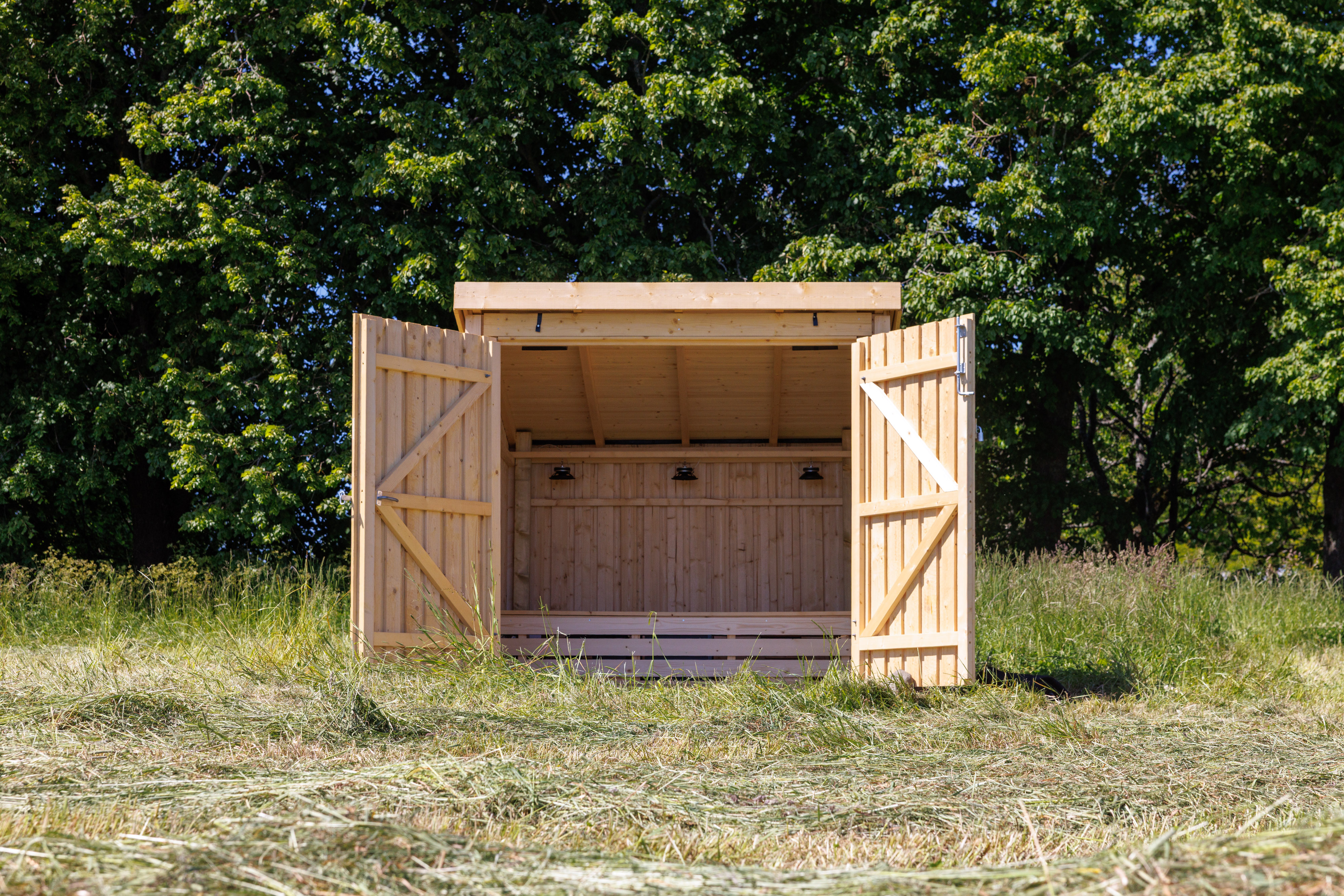
Let me give you instead a positive example: the MOMENTUM biennale in Moss, Norway. There was a very good curator, Morten Søndergaard, and clear communication. We first met on site with the production team. They proposed a room inside, but the acoustics were difficult, and artistically the space just didn't resonate with me. On a later visit we walked around to look for another space. We sat on a bench there, and suddenly the view opened up—it felt just right. I immediately said, “This is the space I want”.
I tried a few ideas with speakers, but nothing really worked. Then I suggested building a simple shed in a field overlooking the Oslofjord, if the farmer whose land it was on would allow it. The curator was open, the institution checked the budget, and eventually we made it possible. I tested the equipment, saw what they had, and brought what I needed. Then I spent a couple of weeks sitting in the shed every day. That’s become my method: to have enough time in the space so the sound grows into the walls.
“In The Unlikely Event of…” wasn’t a completely new work—more a piece built from existing fragments—but it belongs to that shed now. The extra gift was the view that opened up to me from inside: a kind of travelling soundscape. The open doors acted as a frame for the landscape, with birds, insects, people, and the ferry on the fjord between two nearby towns (Horten and Moss) passing by. Looking through that frame—it became such a strong part of the piece.
One of the “situations”—the Darmstädter Ferienkurse 2025’s term for concert–installation hybrids—was the world premiere of Maia Urstad’s 40-minute radiophonic work “IONOS — Music in the Ether”. Written for two performers and an amateur radio operator, it was staged in the Designhaus, a 1909 building with tall French windows and an austere interior that lent the performance a fitting atmosphere.
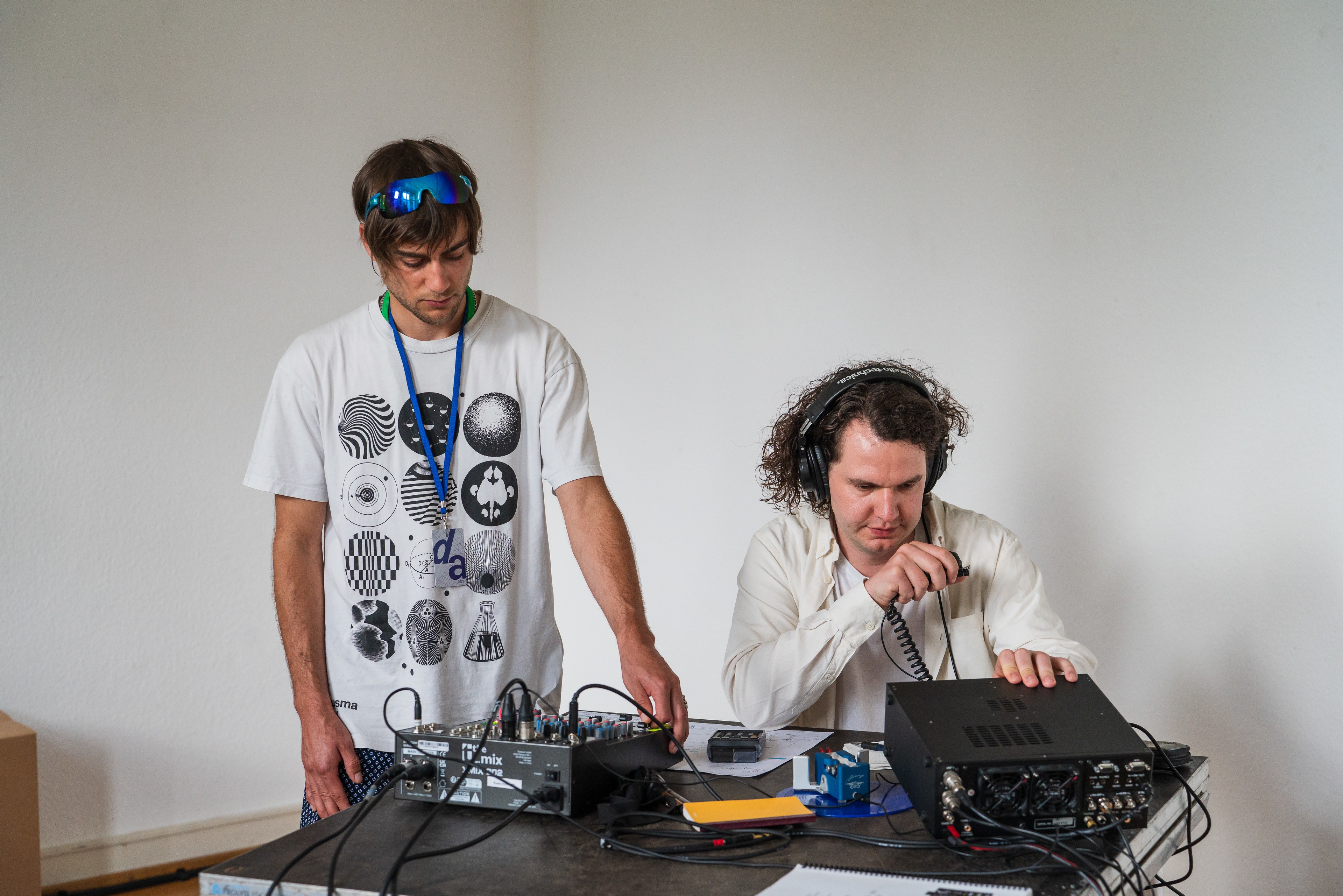
“IONOS — Music in the Ether” was a reworking of a piece first presented at the Borealis festival in 2023, shown here in a hybrid form: both as a performed work and as a sound installation. In the performed version, the audience roamed freely between three rooms, each occupied by one of the musicians: Sofia Jernberg (voice), Ane Marthe Sørlien Holen (percussion) and Erik Chancy (amateur radio operator). To send and receive signals reflected in the ionosphere, Chancy used a short-wave antenna installed in the garden. When tired of walking, audience members could settle onto a cardboard papphocker stool, lending the performance a faintly Martian aesthetic. For the first ten minutes, however, we were instructed to remain seated because of the squeaky floor—one of the many trials and tribulations of staging sound installations.
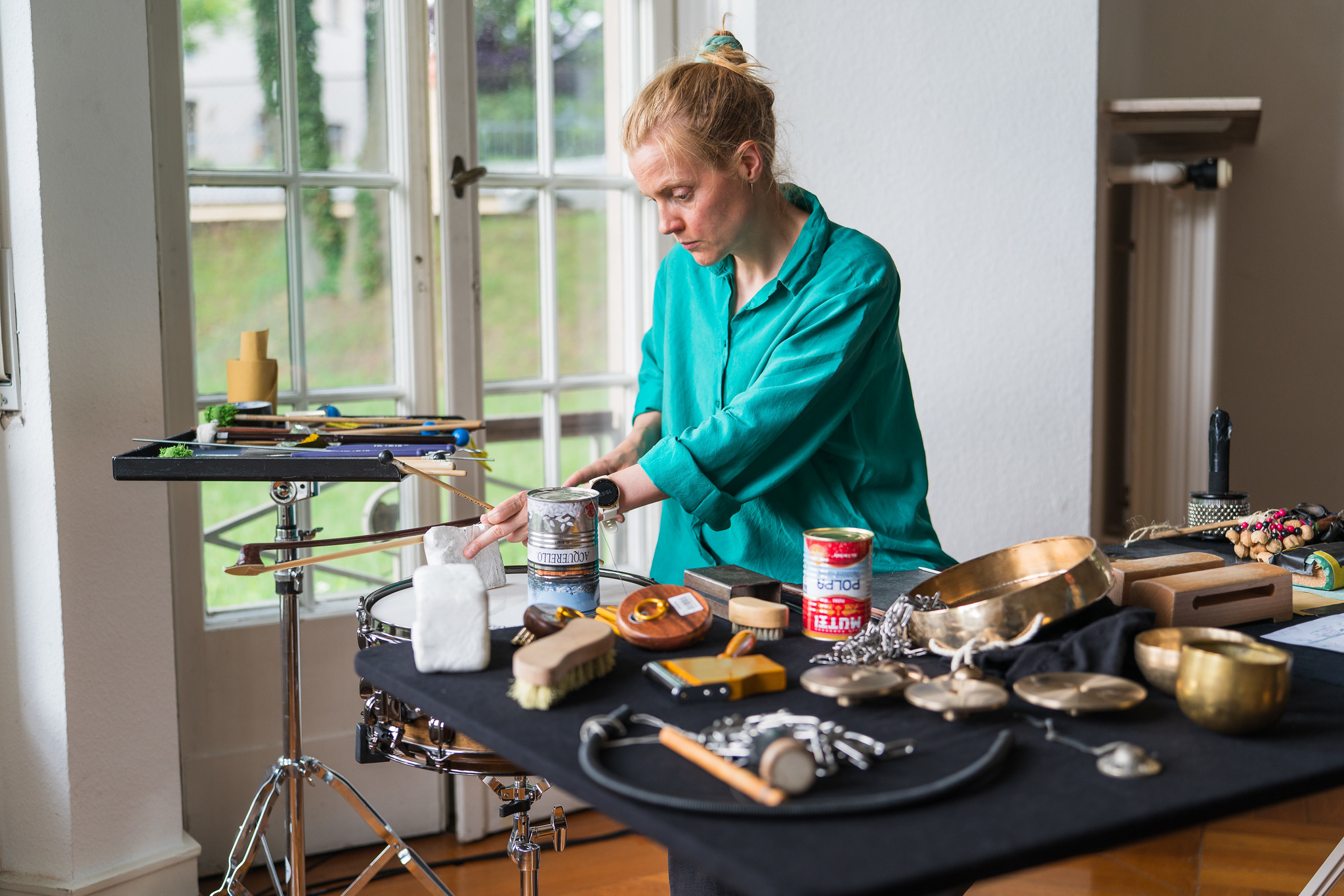
Jernberg’s vocal material ranged from fragile whistles to piercing screeches, while Urstad mixed live and prerecorded sounds as Chancy attempted to reach people over the airwaves. Holen’s percussion setup was eclectic: wood blocks, rattles, old cans, mini-cymbals, bows, mallets, a shoe brush, snare drum, singing bowls—the list seemed endless. The staging was equally striking: some speakers hung overhead, others were angled on the floor, sending sound in unexpected directions. The spare interior of the Designhaus contrasted beautifully with the shifting intensity of sound and voice, making the experience feel at once human and sci-fi.
It was my first encounter with Urstad’s work—and the reason this interview came about.
MI It’s interesting you mention that. I remember you also brought up the view that opened up from the tall windows of Darmstadt’s Designhaus. Let’s talk about that performance. Thomas Schäfer, the artistic director of the Ferienkurse, mentioned that you requested a small audience—around 30 people—for each 40-minute performance, with 12 performances taking place over three days, and that you spent several weeks in the space before the opening. That’s quite unusual in the contemporary music world, where artists usually just arrive, rehearse, perform and leave. Could you tell me more about how that came about?
MU Yes, we had to negotiate that. I think it was two weeks before the performances began. I knew it wasn’t easy because it’s expensive. For music festivals it seems much harder to give artists extended access to spaces, since renting concert venues costs a lot. In the visual art world it’s very different: if you make an exhibition, you always get at least a week for installation—you don’t do it in a day or two. For example, in 2024 I had four weeks at Oslo’s Kunstnernes Hus to prepare “Do You Hear That Whistling Sound?”, which had 104 speakers hanging from the ceiling. I composed that work in the space itself. There were two identical rooms, so two exhibitions ran simultaneously: mine and another sound work.
MI That couldn’t be more different from the music world.
MU Absolutely! At Darmstadt, I imagine the costs are on another level, but for me, time in the space was essential. I had to rework an earlier composition because I realised it wouldn’t function in Designhaus. The venue at Borealis had been a factory hall at Bergen Kjött, while Designhaus consisted of three small interconnected rooms with quite a lot of reverb. I enjoy working with noise, but in that space it became difficult to perceive. Performing the old piece there simply wouldn’t have worked, so I almost had to start from scratch. I dissolved the original idea and reshaped it into something new—the sound really needed to become part of the walls.
MI I remember that when I asked you straight after the performance what the biggest challenge of adapting the piece from Borealis to Darmstadt was, you said, “Pretty much everything!”. So let me turn this around: what stayed the same between the two performances?
MU Amateur radio and communication were the core in both Bergen and Darmstadt. I used the same material as a starting point: a sound environment picked up by a radio amateur from the ionosphere, edited into a multichannel composition and played through eight speakers on the floor. The piece is about how we communicate. In Bergen there were three radio amateurs speaking to each other in the room, sending their signals out. They formed the inner circle, the audience was the outer circle, and the third circle was the speakers.
In Darmstadt, by contrast, Erik—the radio amateur—was in dialogue with the ionosphere, alongside a singer and a percussionist. They were communicating with each other and outward, almost like in Morse code. I asked them to really listen to what the others were playing, before responding—this became essential. In both pieces the underlying idea was that communication means listening as much as speaking. With Morse code or radio you can’t do both at the same time—you send your message, then you stop and listen. That principle became central to the work.
MI And what was curator Carsten Seiffarth’s role in “IONOS — Music in the Ether”? How did you navigate any differences of perspective along the way?
MU Carsten is an experienced curator who has worked a lot with spaces. It was fantastic to discuss ideas with him, because we share a common understanding of what this can be. We’ve collaborated for more than ten years: in 2014, when “singuhr – hoergalerie”, exhibition venue for sound art in Berlin, invited me to do an exhibition; in 2017, when I spent a year as the appointed sound artist of Bonn; and last year with “Sounds of Bethany” in Berlin.
He always pushes me to go a little further, and our strong discussions often advance the work. For Darmstadt, he introduced me to the idea of “situations” and gave me some challenges. He and Thomas had both heard the original version of “IONOS” at Borealis, so they knew what to expect. He suggested two musicians, while I argued for bringing in one radio amateur from Norway who already knew the piece. In the end, I was thrilled to work with such fantastic musicians again—it had been many years since I last did that.
One thing that sometimes provokes curators or institutions is that, as an artist, I always reserve the last word for myself. I say, “I’m the captain.” We can discuss things—even argue—but ultimately I decide. That’s something I’ve learned over many years. Still, there are so many opportunities for dialogue. It was the same in Oslo last year. The curator there, Ida Kierulf, was amazing. She really wanted to understand the content of the work, also because she was writing the curatorial text, while I can be very floaty. We had such good discussions.
MI It seems to me that the most vital ingredient is trust: between artist and institution, with curators who challenge yet listen, and with a shared openness and curiosity that lets the work grow beyond expectation.
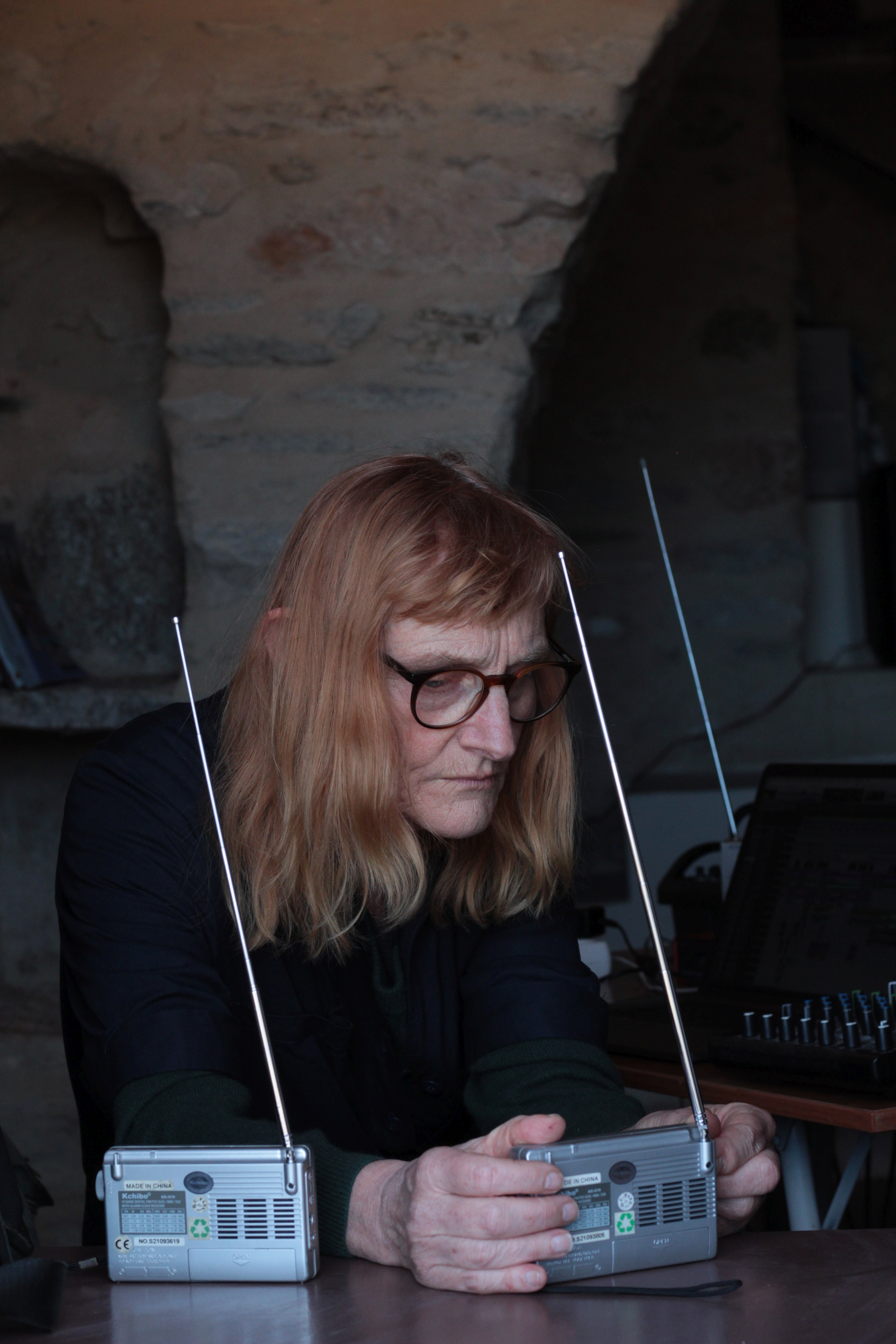
The cover photo shows the artist and composer Maia Urstad © Eva Matsigou
This interview was originally published in Positionen issue #145 in a German translation by Michael Steffens