The contemporary moment is genuinely weird. Across the globe, people are getting married to their AI chatbot partners, while at the same time The White House is spouting violent war threats through social media memes and reels, and tech billionaires build expensive corporate skyscrapers for their work-from-home employees in cities that lack affordable housing. As the world is burning in every sense of the word, we find ourselves today grappling with a moment of global absurdity. Put it this way: would you be surprised should an alien lifeforce invade the planet we collectively call home? Or would you silently shake your head in disbelief, only to then shrug and apathetically move on to the next news headline? Over the past two decades or so, the human boundaries demarcating the levels of uncertainty that we are capable of enduring have shifted tremendously. One of the main driving mechanisms behind this contemporary sense of weirdness is the exponential speed by which technology increasingly dominates and mediates our everyday lives. The almost supernatural warp speed of this development, wedded to sentiments of generalised anxiety amidst a planetary polycrisis, suggests a state of shock that leaves us racing to catch up, grappling to make sense.
The times are weird. Yet somehow, life moves on as the many uncomfortable results of technological acceleration—at times quite literally—get under our skin, probing our bodies. It is under these strenuous auspices that music, as an artform that inherently sits beyond the representational logics of logocentrism and structured rationality, offers a welcome intervention. I emphasise here my use of the word ‘intervention’ rather than ‘repose’. For music, under this current climate of far-reaching technological mediation, is increasingly tapping into the realms of the uncanny. Across a wide variety of musical practices, artists are exploring sentiments of the uncomfortable; the strange and the eerie; the unsettling sense that something is off. In this article, I propose the notion of ‘uncanny aesthetics’ to refer to the purposeful discomfort explored and activated across several strains of contemporary music, be that through sonic, sensuous, or narrative means. I suggest that the rise of uncanny aesthetics in the current moment highlights the prevailing sense that, under advanced capitalism, the familiar is becoming increasingly strange.
It is on a gloomy Sunday morning in Denmark that I fall victim to a classic case of programmed failure or planned obsolescence: the barely three-year-old electric toothbrush my dentist so encouraged me to buy refuses to function. An old-fashioned analogue cleanse ensues but leaves me with a vague sense of dread: the shops are closed, yet my teeth feel dirty. A millennial addicted to advanced capitalism’s promises of instant gratification, I tick off for next-day delivery. I splurge, unwittingly, because surely I cannot scrimp on my health and surely my teeth deserve whatever product the internet adverts tell me is ‘best-in-test’. Once my new toothbrush arrives—inevitably three days ‘late’, whatever that may mean—I brush with never-before-seen ease. As its smart sensor tracks my hand movements, my toothbrush tells me what to do: in what areas to brush, for how long, and when to increase or decrease pressure. I don’t need to think; my toothbrush thinks for me. As an app traces my brushing behaviours, gives me golden stars for two-minute brushing streaks, and pings me when it is time to replace my toothbrush head, the realisation dawns on me: I have become information. Stripped of my human agency, I am now doubled into soulless data, caught in the endless feedback loop of toothbrush fascism. The algorithm trains on me, while I confide in it with all my oral cavity has to offer. A complete invasion of oral privacy.
My experience of toothbrush fascism—deployed here as a metaphor for the many troubling ways in which technological acceleration, as a by-product of advanced capitalism’s incessant efforts to streamline and optimise its circular processes of production and consumption, is encroaching on our bodies—is suggested musically in Michael Maierhof’s schwingende Systeme, B for double quartet (2015–16). The work features its musicians producing aggressively percussive and at times even drone-like clusters of sound by letting electric toothbrushes, heads removed, create friction against single-use plastic objects, such as balloons, crushed and crumpled plastic cups, and scraps of wrapping materials. In its emphasis on non-pitched resonance, the work’s sonic world is suggestive perhaps of war-like scenarios, such as the sound of planes flying overhead, or of other mechanical rumbles and roars—drills, construction sites, industry; buzzing, surging, trembling. Maierhof intersperses these clusters of sound with sudden bursts of silence, that in their sheer duration feel heavy and uncomfortably loud, as if the obvious elephant in the room is deliberately left unacknowledged. The overall atmosphere schwingende Systeme, B exudes is dark, gloomy, and eerily detached—something suggested also in the work’s scenography, in which the ensemble is positioned facing away from each other, shrouded in darkness, with only their hands and tools illuminated with harsh, clinically sterile lighting. Employing consumer waste as its sounding objects (plastic cups, wrappers, balloons) and the epitome of unnecessary technological advancement (the electric toothbrush) as its focal sounding agent, the work is an unmistakable critique of how technology and capitalism have irreversibly coalesced, as well as a rumbling echo of the absurdity of such an unholy alliance.
Nadar Ensemble performing Michael Maierhof’s schwingende Systeme, B for double quartet
A technological invasion of oral privacy is also what is at stake in Rebecca Saunders’ The Mouth for soprano and tape (2018–20). Like in Maierhof’s schwingende Systeme, B, the sounds in this work are thoroughly mediated by technology. In The Mouth, the soprano’s voice is amplified through a series of electronic devices—including three different microphones and speakers—and intermingles with pre-recorded material that is panned out on five different channels. This creates an uncomfortably claustrophobic situation for the soprano, whose voice, or better, whose oral cavity, is sonically amplified to the extreme as breathing sounds, tongue clicks, and lip smacks are foregrounded in an almost violent fashion. Technology, here, makes the interior exterior—the innermost private sounds of the mouth suddenly exposed for all to hear. This tension between interior and exterior worlds is not just foregrounded sonically, but also textually, as Saunders erratically shifts from fragmentary, stream-of-consciousness thoughts and incoherent vocal murmurs, to more fully-formed sentences and ideas: a textual mirror of the many entanglements between the metaphorical inner voice and its externalised, worldly counterpart. Furthermore, the work is set up to explicitly blend the acoustic, real-life and the technologically mediated, prerecorded voice of the performer as much as possible. The sonic result is unsettling to say the least. As the boundaries between real and digital, internal and external coalesce, the listener is left feeling disoriented, perhaps even betrayed, as they are purposefully debilitated in discerning between what’s live and what’s recorded; what’s real and what’s virtual; what’s private and what’s not.
A similar dynamic sits at the heart of toothbrush fascism, or, to be more precise: the contemporary phenomenon of far-reaching technological acceleration under advanced capitalism. Under this all-encompassing regime, algorithms continually track, mine and record our most sacred personal thoughts and behaviours—from the however-many-star reviews we leave small businesses, to the photos of our children we send to a family member, and even the ways in which we deal with loss and grief. If that weren’t enough, this data is then explicitly used against us. It is exposed for all the world to see and commodified in an attempt to steer and ultimately control our attention and purchasing behaviours—in the shape of advertisements for other, related businesses, toys to buy for said children, and ‘smart’ ways to grapple with loss via interactive ‘griefbots’ or promises of digital afterlives. The mouth offers an interesting metaphor here. For the mouth is not merely an instrument, a sonic human tentacle into the world. It is also a liminal space that symbolises the thresholds between two worlds: one internal, one external; one private, one public. Like a toothbrush, technological acceleration under advanced capitalism has penetrated this sacred boundary (and, unlike a toothbrush) left it irreversibly damaged. The mouth is also a way in: a fleshy entrance; a direct pathway to the intestinal and, by extension, the body as a whole.
For technological acceleration knows no boundaries, and especially not fleshy ones. In the ongoing Holly+ project (2022–), a collaborative effort between artist duo Holly Herndon and Mat Dryhurst, a custom-built neural network was trained to replicate Herndon’s voice, much like a musical deepfake; a vocal clone. In this respect, Holly+ presents a thoroughly contemporary take on the doppelgänger. End users can now license the software to effectively sing through Herndon, realistically transforming the vocal input from their voice to hers in real-time. Considering Roland Barthes’ writing on how each human voice has a uniquely individual ‘grain’ or timbre—the reason why you can tell you are on the phone with your aunt, and not your sister—the sonic result is uncanny to say the least. This is partly due to the mismatch between the visual and the aural; the inevitable discrepancy between who we see is vocalising versus who we hear. Herndon plays with this in the extensive marketing campaign around the project, featuring images in which her face is either visually distorted or in which she is simply doubled—multiplied or fragmented into many same-similar Hollys. To mark the launch of the project back in 2022, Herndon released a cover version of Dolly Parton’s Jolene (1974) featuring vocals engineered by Holly+. While the music foregrounds the AI double’s ‘unrealness’ through exaggerated breaths, overtly weird pronunciations, and a way-too-polished timbral ‘roundness’, the choice for Jolene hints towards something darker, perhaps more macabre. Whereas Parton’s original laments a lost love, a lover unrightfully ‘taken’, the technology behind Herndon’s cover suggests quite the opposite—it is an open invitation for anyone willing to freely come and possess one of the artist’s most intimate and defining qualities: her voice.
As with all things in life, there are, of course, many positive sides to this story. For one, Herndon—or at least her digital, artificially intelligent double—can now sing in expanded registers, languages, repertoires, and has never-before-seen (and/or heard) technical capacities which are no longer limited to what is humanly possible. For instance, the artist can now duet with herself. The project also opens up novel opportunities for artistic collaboration either online, offline, or even asynchronously. The technological innovations that underpin Holly+ and the project’s potential implications for the music industry at large—both developments foreshadowed perhaps in slightly more rudimentary fashion by Jennifer Walshe and Memo Akten’s work on GRANNMA (Granular Neural Music & Audio with Magnitude Networks) and ULTRACHUNK back in 2018—are beside the question. Yet beneath the surface lurks the unsettling realisation that in Holly+, the body is not just copied by and in technology; it is made redundant. In theory—that is to say, if the software has not become obsolete by then—Herndon’s voice, unburdened by its fleshy home, can outlive the artist and eventually vocalise her—speaking both from and for her—from beyond the grave. The artist’s voice, once precious and unique, is now disembodied and commodified, available to the masses in its pure datafied virtuality.
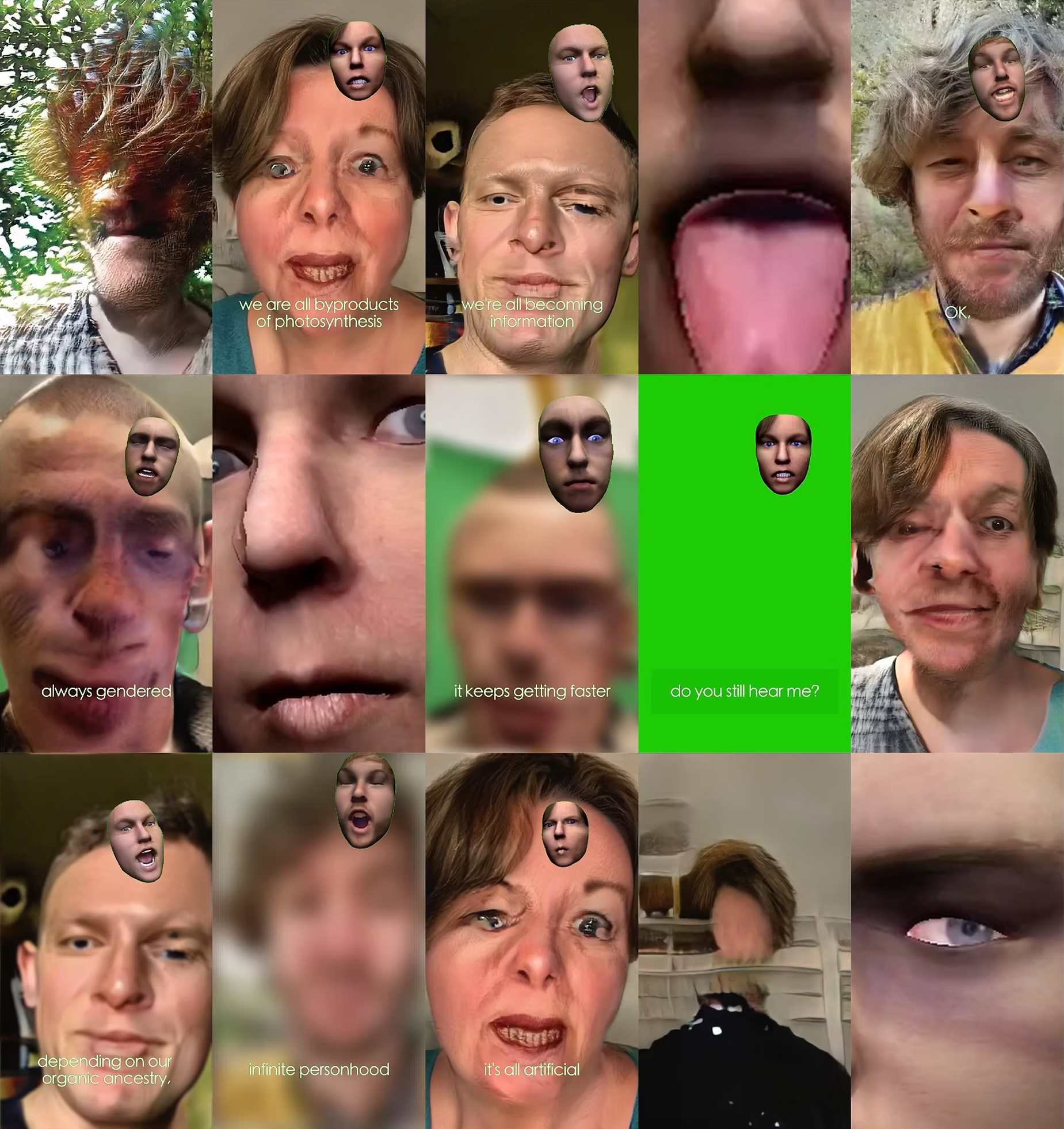
MICHAELBRAILEY, THISPERSONDOESNOTEXIST (2021). Generative audiovisual work, duration variable
Similarly stripped from their human bodies and agencies are the AI-generated protagonists in MICHAELBRAILEY’s audiovisual work THISPERSONDOESNOTEXIST (2021). These virtual beings are based on—or rather harvested from—real people, in this case, an ‘ethically sourced’ or ‘consentual’ dataset trained on the faces and voices of the members of composer-performer collective Bastard Assignments (Timothy Cape, Edward Henderson, Caitlin Rowley, and Josh Spear). Yet these figures’ uncanniness does not stem from them being a close-to-exact copy of their original, fleshy counterpart. On the contrary, MICHAELBRAILEY’s protagonists are purposefully distorted figures, exhibiting glitchy mannerisms, grotesque facial features and exaggerated vocal inflictions. They are not by any means doppelgängers but rather unnervingly vague traces of their human sources. The AI-generated beings in THISPERSONDOESNOTEXIST appear to resist their own existence; they are at times even disgusted by the very fact that they exist. Stripped from their originary bodies, identities and agencies, and now being puppeteered in their datafied form, MICHAELBRAILEY’s strange creatures vocalise that they simply do not wish to exist. ‘I don’t want to look like you’, claims one of the creatures, while another one cries that ‘being myself—it’s something just out of reach’. While grasping at whatever traces remain of their identity (‘Sorry, Tim isn’t here right now’), the creatures also fear what will happen to them after they are no longer of use to whoever forced them into being and they are inevitably discarded into the virtual void (‘Are you still here?’, ‘You cannot kill me!’, ‘Are you hopeful for the future?’, and ‘Do you even give a shit?’). In this respect, MICHAELBRAILEY’s work highlights the deeply troubled relationship between technological acceleration and advanced capitalism: artificial intelligence operates on the very premises of consumer waste. Not only does it waste resources, it also uses scraped data to create single-use products, ad infinitum.
These and other examples of uncanny aesthetics signal a society that is mid-transformation; a makeshift moment of planetary absurdity. Under a technocapitalist regime that optimises predictability, mineability and control, weirdness and unease are perhaps among the last remaining forms of resistance. In all its unsettling and stomach-churning gloriousness, the uncanny makes us see things for what they really are: intensely weird and eerily disorienting. Because when the familiar turns strange, alarm bells should start sounding. The technologically saturated present raises a number of pertinent and urgent questions about identity, agency and more-than-human coexistence. The uncanny, perhaps best described as a gut feeling; a necessarily embodied sensuous experience, might offer a way out that machine thinking can never appropriate. While human reason may have gotten us into this mess, it is not too late for that very same human creativity to help us get back out. Messy times call for messier music.
Cover Image:
© MICHAELBRAILEY, THISPERSONDOESNOTEXIST (2021). Generative audiovisual work, duration variable. Concept, sound, text, video, programming – MICHAELBRAILEY. Performance, sound/image input dataset – Bastard Assignments (Timothy Cape, Edward Henderson, Caitlin Rowley, Josh Spear). StyleGAN-2-based neural network – Laura Ibáñez. Commissioned by Bastard Assignments for Lockdown Jams.