There are people whom it is difficult to imagine no longer being there one day, because they have inscribed themselves into your own thinking in such a singular way. Not only as a friend, as someone across from you, but as a kind of inner interlocutor who keeps talking, contradicting, laughing, doubting, asking questions even when you yourself no longer know how to go on. Andreas Engström was such a person for me. And perhaps that is precisely why this farewell feels so final.
We had known each other before Positionen, in the way people tend to get to know one another in this small, often slightly too small world of contemporary music. You meet at festivals, at concerts, in conversations—at some point in Berlin, at some point in Munich, at some point after midnight, at some point with a drink in your hand and a question that has once again become far too fundamental. But we really became closer in 2018. Andreas was in Munich for the Ernst von Siemens Music Prize ceremony and was looking for somewhere to stay for a few days. I still remember how he arrived: with that particular mixture of reserve and presence that was so characteristic of him, of mischief, scepticism and warmth, and with a knowledge that never needed to be put on display and was all the more present for it.
Andreas had character. That may sound banal, but it is not. Many people have opinions, positions, tastes, professional profiles. Andreas had character. A wonderful intelligence, a dry and sometimes eccentric sense of humour, an attentiveness to side roads, to music off the beaten track, to the ramifications of biographies, to scenes that were not immediately in the spotlight. He could be very kind and, at the same time, mercilessly precise. He could laugh warmly and, a moment later, make a remark that caused an entire cultural-political constellation to collapse in on itself. He was not simply a creature of the cultural establishment. He exposed himself to it, knew it, needed it too, but never quite believed in it.
Then came the offer to take over Positionen. Andreas asked me whether I wanted to do it together with him. Looking back, that question now seems like the beginning of a great shared adventure, but at the time it was very concrete: Did we want to continue this magazine, this journal, this place for thinking and speaking about contemporary music together? Did we want not simply to manage what was already there, but to change something? Did we want to take on this task, with all its hopes and all its effort, all the invoices, emails, overdue texts, printing deadlines, disagreements—all the things that stand behind a magazine and that, in the end, no one ever sees?
We did.
And what was remarkable was that we agreed. On the big questions, we found ourselves astonishingly close very quickly. We did not want to continue a magazine merely because it had existed for a long time. We did not want it to be a vehicle for a scene congratulating itself. We wanted to relaunch Positionen, both editorially and in terms of its design. We wanted to open the magazine up, sharpen it, question it anew. What is contemporary music? Who speaks about it? Who is heard? Which terms still mean something, and which have become little more than empty but well-funded habits? What can a magazine still do in a present that speaks so quickly and listens so poorly?
For many years after that, we spoke almost every day. We saw each other often—sometimes in person, often by video call. I think that during those years I saw Andreas more often than I saw my partner. There was this everyday intimacy of working together: brief check-ins, long discussions, grand plans, small catastrophes. Sometimes it was about a text, sometimes a headline, sometimes an author, sometimes money, sometimes an entire issue, sometimes simply the question of whether an idea really held up or was merely pretending to. And then, at other times, it was about everything: music, politics, Berlin, Sweden, the scene, art, exhaustion, illness, friendship.
Perhaps one of his great abilities was simply this: he knew how to listen. He listened closely. He listened to music, to voices, to scenes, to atmospheres, to what was being said and to what people would rather leave unsaid. He was interested in folk and world music, in subcultures, in developments in Central Europe, the Middle East and Southeast Asia, in all those musical and cultural contexts that cannot be understood if one thinks only within the familiar maps of funding bodies and festivals. Andreas returned from his travels with a kind of knowledge that consisted of more than facts. It was knowledge born of experience. Knowledge of people, places, conversations, political tensions, small scenes, strange concerts, bad hotels, good evenings—of all the things that make music a social reality in the first place.
Andreas was a musicologist, editor, curator and critic. He studied musicology in Sweden and worked as a freelance writer, editor and critic for numerous publications across Europe, including Dagens Nyheter, Svenska Dagbladet, Seismograf, Tempo and many others. For many years he was editor-in-chief of the Swedish music journal Nutida Musik and contributed as an author and co-author to important publications on sound art and art music in Scandinavia. In Berlin, he was one of the initiators and curators of KONTRAKLANG, the concert series whose discontinuation following the loss of public funding has left a gap that can still be felt today. His voice was equally important on juries, among them that of the inm – initiative neue musik berlin.
He belonged to that increasingly rare group of thinkers about music who did not simply adopt the spirit of the times. He was not someone who amplified trends. Nor was he a nostalgic preservationist. He was something more difficult: someone who wanted to examine what was being claimed at any given moment. What does it actually mean when everyone suddenly starts talking about discourse? What does diversity mean if the structures of decision-making remain unchanged? What happens when a festival reinvents itself but merely replaces its rhetoric? What is criticism worth if it never hurts anyone? And what is music criticism if it is no longer willing to annoy anybody?
Andreas knew how to argue, out of respect for the subject itself. He loved debate and actively sought it out. That did not always make him easy to deal with. How could it? A truly alert person is rarely comfortable. His writing was uncompromising and honest, as music criticism should be and so rarely is. At times, we suffered alongside him precisely because of this. Sometimes it was exhausting, sometimes it was too much, sometimes one wished he could take things a little more lightly. But then he would not have been Andreas. And deep down, we knew that this precision, this refusal to let go, this unwillingness to become false for the sake of politeness, was one of his great qualities.
Over time, things changed. The pandemic shifted many things. I increasingly oriented my life towards Munich, new working rhythms emerged, everyday life was reorganised. And it was during this period that Andreas first received his diagnosis. Cancer. A word that suddenly changes everything. For years, Andreas and I tried to make the two realities coexist: producing a magazine while undergoing treatment. Editing texts while the body could no longer be taken for granted. Planning issues while appointments at hospitals became ever more important. Continuing to think ahead while the future was narrowing. Eventually, it was no longer possible.
I miss you, Andreas. I already missed you while you were ill. Because the lightness of our daily excitements became less frequent. Because not every subject could automatically turn into a long conversation anymore. Because one began to realise that something that had once seemed almost endless—this work, this thinking, this back and forth of sentences, this shared attempt to shape a musical world—was finite. And now I miss you even more. The reality is too definitive. Too final for someone still so young.
I would have liked to go on doing this with you for many more years. I would have liked to plan many more issues with you, start many more arguments, move many more texts around, persuade many more authors, answer many more emails too late, curse many more funding structures, put many more concepts to the test. I would have liked to receive many more of your excited phone calls, in which you would immediately plunge into the middle of the matter, without much introduction, as though the conversation had never stopped. I would have liked to keep smiling with you about the music world—about its absurdities, its vanities, its great possibilities, its petty cruelties. And I would have liked to continue sharing that particular understanding we had: that things must be taken seriously precisely because they are sometimes so absurd.
Andreas spent his final years in Sweden, surrounded by his family and friends. Our deepest sympathy goes to them. They have lost a son, a loved one, a friend. We have lost a colleague, a thinker, an editor, a curator, a critic. I have lost a friend and a person with whom I shared a decisive part of my life and work.
What remains? The issues remain, the texts remain, the memories remain. But that sounds like too little. Because Andreas remains not only in what he made and did. He remains in the way we can continue to think about music: more precisely, more independently, less opportunistically, less satisfied with easy answers. He remains as a voice that will not simply disappear.
Dear Andreas, I miss you.
Bastian
Publisher, Positionen – Texte zur aktuellen Musik
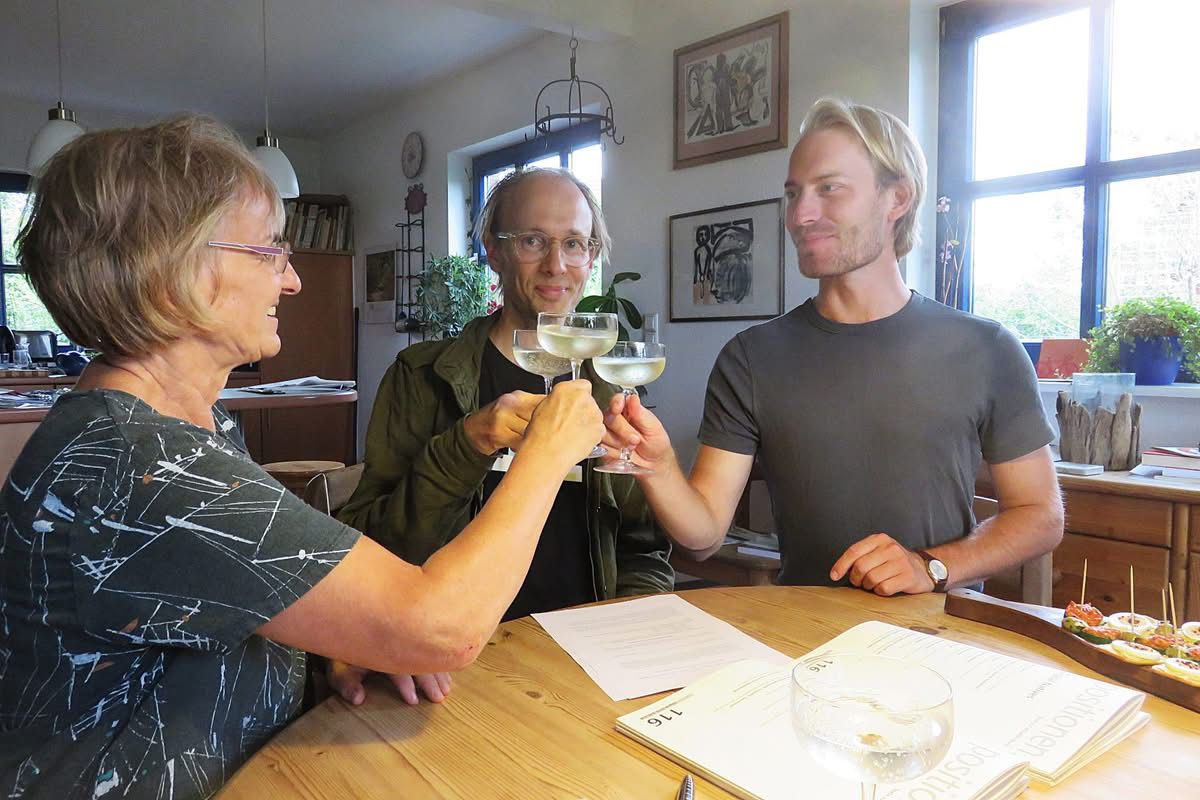
Photo credit: Andreas Engström and Bastian Zimmermann at the handover of Positionen magazine by its co-founder and long-standing editor Gisela Nauck in 2018 © Peter Wicke