This article is my answer to a question posed to me 25 years ago by Dai Griffiths, when I was running Oxford Contemporary Music (OCM) and he was a Music Professor at Oxford Brookes University. The question – ‘In OCM, is “contemporary” deliberately used? Not modern? Not new?’ – remains…contemporary. This is not only because the term both saturates and haunts the scene – whether directly (hcmf//), indirectly (Ultima: Oslo Contemporary Music Festival), ambivalently (the International Society for Contemporary Music is, in German, Die Internationale Gesellschaft für Neue Musik), or obliquely (Positionen’s byline of ‘Texte zur aktuellen Musik’ avoids the term but its baggage trails not far behind). The persistence of the question and the fatigue of avoiding its implications are symptoms of a broader problematic, contemporaneity, that paradoxically both names an historical period and disturbs the gesture of denominating eras in the same gesture. It registers an uncertain time whose periodization is constitutively in doubt, disorienting any value framework predicated on a singular historical line – for example, of ‘art’ or ‘music’. The question of the contemporary – to which the art theory journal October dedicated a 2009 issue – designates the problem of ascribing artistic value as a matter of (historical) time, an eminently curatorial concern.
Contemporaneity marks an anxious time without defining features. It lacks a clear beginning. For example, ‘contemporary music’ has referenced music post-1945, post-1960, and post-1989, broadly aligned with the decline of modernism, and the rise and fall of postmodernism. Modernism is often understood as a reflexive mechanism of historical negation, a historical sensibility that comprehends its own historical trajectory, granting its historicity a sense of direction – a ‘logical necessity’ that underpinned Schoenberg’s dialectical aesthetic, for example. He did not choose serialism, but claimed it as an historical imperative. Boulez’s posture that ‘Schoenberg est mort!’ carries a similar negative charge. ‘Post’ modernism then signalled a paradox, a break with modernism that still appeared as its negation, thereby implicitly continuing modernism by other means. Contemporaneity is the spanner in the workings of this mechanism, whose control functions included the heroic ‘subject of History’, the agent capable of directing its course, whether a Napoleon (or a Kissinger, Thiel, or Blair) or a canonized artist. It puts brakes on modernism’s forward drive.
Even as late modernity accelerates daily, it goes nowhere and has neither destiny nor destination. It is symptomatic that the term ‘Generation X’ shifted from a signifier for alienated youth to the first in a sequence of alphabetised denominators – Gen Y, Gen Z, Gen Alpha, Gen Beta – marked not by specific historical events but by a mere passage of chronological time. This contemporaneity has characteristics of a mise-en-abîme, a post-post-post-post-romanticism / minimalism / complexity etc. Margaret Thatcher similarly (and not coincidentally) claimed ‘There Is No Alternative’ (TINA) to neoliberal capitalism. Contemporaneity registers TINA’s vacuity and aimlessness, whilst harbouring desires for an ending to this ‘capitalist realism’ (as Mark Fisher termed it). With no clear way forward, no jail break from market fundamentalism, many practitioners have sought to transfigure the present by returning to the past. We see this in rediscoveries and the summoning of historical ghosts: ‘hauntings’ of the present by historical possibilities that were passed over – whether radical Black artists like Julius Eastman, or assassinations of anticolonial or progressive political leaders. Such recuperative projects fail to change our moment, however, as soon as music disinterred is then embalmed, entered back into an expanded, revised, or parallel series of developments that follow the same canonical logic.
Complicating matters further, at the time Griffiths posed the question, ‘contemporary music’ in the UK often indicated music that was not ‘classical’. At Arts Council England, the Contemporary Music Officer was responsible for jazz, some world music, alternative rock, art pop and so on. New composition fell under the remit of the Classical Music Officer. At London’s Southbank Centre, contemporary music referred to festival programmes such as Ether and Meltdown, which covered electronica, adventurous rock and pop. Still in its relative infancy, amazon.com listed CDs under categories of ‘Music’ and ‘Classical Music’, a similar division in which a 1997 recording of Xenakis’s Kraanerg featuring DJ Spooky appeared under the former whilst the 1969 premiere LP could be found in the latter. It was as if, freighted with the historical ballast of the classical – with its whiff of Greek and Roman antiquity – new ‘classical’ music was anachronistic, not of the same time or ‘vintage’ as ‘contemporary music’. It tasted over-ripe, perhaps. A bit sour. Destined for the cellar rather than the party.
Griffiths pointed to this in a follow-up question. As OCM presented new composition, jazz, folk and world musics (and noise, improv, electronica and more), were there ‘excluded genres’? Could Country and Western be in the programme, or Robbie Williams? I improvised an answer that OCM was like a white cube in which I could curate anything that was convincing, that stuck, any ‘readymade’ or ‘found musical object’ that wouldn’t be mistaken for an actual fire extinguisher or pile of earth, for example. It was a ‘get out of jail’ answer, but it also implied an opening towards the answer that I am coming to, a quarter century later.
The question of genre touched on value equivalence, the idea that in the wake of postmodernism – and of the New Musicology – there was no ontological difference to underpin musical distinctions of art, folk, pop, and so on. Here, all music appears equally ‘contemporary’, understood as simply ‘of the present’. Similarly, abandoning the racist and colonial heritage of marking some cultures as ‘prehistoric’ or primitive, whilst evaluating even those granted inclusion amongst the ‘historical’ cultures as more or less advanced, seemed to require flattening historical distinctions. As the critical anthropologist and philosopher Johannes Fabian famously put it in Time and the Other, what was required was co-evality, a recognition of the shared, non-hierarchical time (and space) of the West and its Others, the ethnographer and their observed subjects.[1] The distinction in the visual arts between ‘contemporary art’ and ethnographic collections began to collapse as its Western geopolitical assumptions – marking an inside and outside, advanced and primitive, centre and periphery – were deconstructed. In visual arts discourse, contemporaneity has figured as this historical time in which spatial distinctions have been replaced by the co-existence of multiple different temporal orders.
What remained of claims to distinction were discourses and cultural forms structured by power relationships that could be exposed and identity formations to be celebrated. In a peculiar revanchist twist, classical music could be rehabilitated from its time-worn elegance and upgraded to a contemporary practice by re-narrating its diversifying canon, expanding repertoire, popular history (alongside its elitist habits) and global influence. Supposedly ‘anti-populist’ new music was beyond the pale, however, for its obstinate insistence on a value difference rather than equivalence. Steve Reich’s repeated claims that he and other minimalists connected with the proverbial ‘man in the street’ whilst avant-garde composers shunned society is, in this sense, a claim for legitimate contemporaneity. TINA’s pre-eminent musical paradigm, meanwhile, has perhaps been hybridity, a re-organisation or superposition of styles and fragments that proliferates endlessly, with Spotify now identifying over 6000 genres, a framework ideal for text-prompt AI music generators.
This is not an argument against hybridity, only an acknowledgement that it is insufficient in itself as an answer to the value question posed by ‘the curatorial’ – a term that insists on value claims against the proliferation of ‘curationism’, the fashion for ‘curating’ everything from restaurant menus to news agendas.[2] In the time since Griffiths’s awkward question, I’ve written a PhD and published several articles and a book addressing musicality and the curatorial. The curatorial is distinct from curating which separates what it brings together – production and reception, artworks and audiences. Curating selects, mediates, and stages art whose value is assumed to precede its public encounter, yet the rhetorical force of the language of curating cannot magically conjure a distinction. There is not a kind of music that is curated whilst others are simply programmed or produced. Nor can Sound Art be determined as a legitimate object of curation in contrast with music that is not.
The value question cannot be resolved by reclaiming an ontological difference – a genre, style, mode of practice or cultural form – that precedes the moment of encounter. Nor can value be determined as a corollary of relative advancement, of being more contemporary than other experiences. It can, however, be approached through the curatorial as a mode of encounter itself, a conjunction of artist practice and public experience whose meaning is co-produced.
Time, here, is not value neutral or value equivalent. Unlike Louis Armstrong’s quip that there are two kinds of music, good and bad, time cannot be divided in evaluative terms so easily. Few mothers would say childbirth was a pleasure, for example, and anyone who has held the hand of a dying parent would not treasure that moment any the less for it being ‘bad’. Good times don’t last forever, and even if bad times seem to be settling in for the long term, they too are impermanent. If somebody promises you ‘a good time’, it’s best to walk away. Good times cannot be economised, measured and priced: it is hard to claim that the duration of a performance experienced from the stalls or executive box is orders of magnitude better than the same time spent listening and watching from the cheap seats. For all its metaphors of saving, spending, and banking, time is stubbornly resistant to being deposited – except in memory or documentation, which require further time to be reanimated (hence also the material problems time-based arts create for archival systems). It can be exchanged in the form of labour time, but this involves an implicit and sometimes explicit coercion. Waged labour is not a choice for those without inherited wealth. Even when salaried, time lacks ‘equivalence’ in the form of a medium – a coinage – that would allow it to be exchanged because it cannot be lived twice. For all of the Epstein class’s fascination with living forever, with ‘improving’ human DNA, or living on by ‘seeding’ the human race, even their billionaire ‘fortunes’ can at best delay and not deny their death.
It is significant, then, that for at least two decades curatorial theory has been turning from work- and object-based concerns to questions of time – of process, projects, relation, and performance – and of the meaningful articulation of public encounters. The notion that curating does not simply transmit or objectively interpret artworks but affects the conditions within which publics experience them and produce meanings led to contested accounts of ‘performative curating’ shortly after the turn of the millennium.[3] As a mode of performance, exhibitions ‘staged’ their effects in time; their value for meaning – rather than for insurance purposes or resale – had the character of an event. The discourse on historicising exhibitions, which began by canonising particular shows and their curators, likewise began drawing attention to the ambivalent ways in which exhibitions both present and perform ‘history’. Exhibitions not only make historical claims – of artistic relevance, of the artworks’ relations to art history and to current issues; they also claim historical significance of their own.[4]
This temporal understanding of curatorial work has been led by the gallery arts, which usually retain their visual privilege even as their institutions have become ever more porous with greater emphasis on performance, sound, dance, and even music.[5] It is indicative, here, that of the 20 short books on ‘The Contemporary Condition’ published by Sternberg Press, none draws on musical experience or practice. For example, Terry Smith’s The Contemporary Composition elaborates a sophisticated account of prominent modes of curatorial practice – associated with established museums and galleries, biennials, and DIY or alternative (or online) spaces respectively – according to how they figure contemporaneity.[6] Curatorial mediation, the making public of artistic practices, becomes here a task of ‘world picturing’. He draws on Gertrude Stein and Bruno Latour for considerations of composition, not from George Lewis, Liza Lim, or Kendrick Lamar.
Similarly, in his feature essay for The Global Contemporary, Peter Weibel situates the task now as one of ‘rewriting’, a mode of addressing art historically in its plurality: that is, after a globalizing art market and system confronted postcolonial art worlds that refused to be accommodated under a singular, Western art history.[7] ‘Rewriting’ concerns the legibility of art in a time without a universal grammar or syntax, a notion that resonates with Hans Belting’s proposition that ‘curating art after the global turn means translating art for new audiences.’[8] Performance practices that do not privilege the sign, textual signification, or conceptual understanding but that recognise the equal importance of embodiment, feeling, touch, listening, relation, and rhythm might problematise this metaphor of translation and its framing of legibility. Aesthetic encounters need not resolve in a claim for what constitutes their contemporaneity, but can also be felt and enfleshed in memory that remains when the music ends.
The temporal turn in this discourse has even prompted Beatrice von Bismarck to advance the (somewhat tortuous) neologism ‘curatoriality’ to signal the conditions of forming or shaping – or composing, perhaps – meaning in and through exhibition-making.[9] Articulated as a constellation of artworks, display techniques, gallery infrastructure, and people – staff, performers, viewers etc – entering a space of signification, a site set apart for the public production of meaning, she describes a dynamic situation in which the relations between these elements are constantly changing – like a Calder mobile, perhaps – without a central organising or controlling function from the moment of public encounter. ‘The curatorial situation [thereby] takes on qualities of the performing arts,’ – von Bismarck names theatre and dance, not music – as its iterations always differ, even repeat performances, forming ever new constellations. She could be describing one of John Cage’s exhibition compositions.[10]
It could be argued that every music performance shares this characteristic of temporal form becoming public, yet not all musical forms and their modes of public encounter have the same value structure. The temporality of wonder differs from that of satisfaction. Inhabiting and co-producing time together involves not just differences but value differences. This recognition has been key to recent interventions in the philosophies of history, notably François Hartog’s Regimes of Historicity, a kind of history of historiography observing shifts in social constructs of time that resonate in contemporaneous musical constructs of time. For example, in marking a shift from cyclical to linear orders of time from Baroque to Classical, Karol Berger observes that
In a fugue, unlike in a sonata, we are not usually sure where we are within the piece, nor does understanding what goes on at any given moment depend on such awareness… . The same contrast obtains between Bach and Mozart concerto movements: in a Mozart concerto movement the moment of the ending can, and is, anticipated almost from the beginning; in concerto movement by Bach it is not.[11]
It also underlies accounts of how recent American operas address historical material, such as Philip Glass and Allen Ginsberg’s Hydrogen Jukebox.[12] More directly, the chronopolitics of historical sensibility also operate as a political tool.[13]
In short, curatorial modes of encounter afford different experiences of time through which the question of value can be approached. For example, curatoriality invokes a value through a mode of composition that decentres power relations. This resonates with Jean-Luc Nancy’s provocation that in the absence of a pre-existing schema or formal distinction – a value form, say, or musical genre or privileged institutional setting – making art public today requires the form of a gesture, an act that cannot be reduced to an intentional meaning but that invites audiences to confer the sense of a meaning that is always deferred.[14] It signals the possibility of a world unfolding itself, an unheralded but meaningful configuration.
Whilst it’s taken me a generation to sketch out this response to Griffiths’s question, this is not a conclusive or final answer. Curating contemporaneity is not a state of understanding or set mode of production from which we can move on, progress, or negate, but a question posed anew, continually, in the search for meaningful ways of being with others. We can encounter it in action in surprising ways, as I did last September at Ultima Festival with In this time, choreographer Tale Dolven’s black box presentation in collaboration with pianist Alain Franco, dancing, performing, and talking about time in Beethoven’s Hammerklavier and Les adieux sonatas alongside recent works like Joanna Baillie’s Artificial Environment No.8. I’ve experienced this infectious sense of possibility and saturation of memory with the Palestinian Sound Archive at London’s Café OTO, and in the curious expectancy in play for a series of free improv collaborations with Heiner Goebbels at hcmf//. Each encounter, co-constituted with others, opens the possibility of another world. That’s something we all need.
---
Ed McKeon writes, lectures, produces, researches, reads, edits, initiates, supports, challenges, listens, and (rarely) performs. GSOH – arguable. Seeks readers and correspondents who may do any of the above.
[1] Johannes Fabian, Time and the Other: How Anthropology Makes Its Object. New York: Columbia University Press, 1983 / 2014.
[2] David Balzer, Curationism: How Curating Took Over the Art World and Everything Else. London: Pluto Press, 2015.
[3] Alex Farquharson, ‘I Curate, You Curate, We Curate.’ Art Monthly 269 (2003): 7-10; Maria Lind (ed.), Performing the Curatorial. Berlin: Sternberg Press, 2012.
[4] Rike Frank and Beatrice von Bismarck, Of(f) Our Times: Curatorial Anachronics. Westfalen: Sternberg Press, 2019.
[5] See my article ‘The Past Isn’t What It Used To Be’ in Positionen #135 (May 2023).
[6] Terry Smith, The Contemporary Composition. Berlin: Sternberg Press, 2016.
[7] Hans Belting, Andrea Buddensieg, and Peter Weibel (ed.s), The Global Contemporary and the Rise of New Art Worlds. Cambridge, MA: ZKM / MIT, 2012.
[8] Ibid., 29.
[9] Beatrice von Bismarck, The Curatorial Condition. London: Sternberg Press, 2022.
[10] See my review of Sandra Skurvida, John Cage. Composing, Computing, and Curating in Positionen #145 (Nov 2025).
[11] Karol Berger, Bach’s Cycle, Mozart’s Arrow: An Essay on the Origins of Musical Modernity. Berkeley, CA: University of California Press, 2007, p. 8.
[12] Colleen Renihan, The Operatic Archive: American Opera as History. Oxon: Routledge, 2020.
[13] Christopher Clark has inverted Hartog’s schema to examine the ‘historicity of regimes’, the way that different German leaders – between 1640 and 1945 – used temporal frameworks to justify their actions in exercising power. ‘Each possessed a distinctive temporal signature. Each moved to a different temporal music.’ Christopher Clark, Time and Power: Visions of History in German Politics, From the Thirty Years’ War to the Third Reich. Oxford: Princeton University Press, 2019: 211.
[14] Jean-Luc Nancy, ‘Art Today.’ Journal of Visual Culture 9/1 (2010): 91-99. I develop this in ‘Throwing and Catching’, in Jennifer Johnson, Rachel Coombes, and Tim Coombes (ed.s), Art and Gesture in the Long Twentieth Century: Ontology, Politics, Affect. Leiden: Brill (forthcoming).
Main Image:
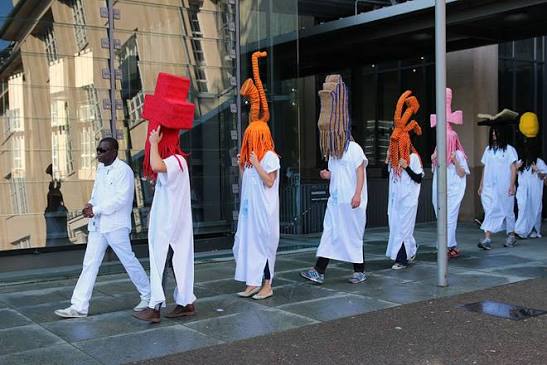
Meschac GabaMusée de l’Art de la Vie Active. 2010/2011Performance © Foto: Haupt & Binder